NFPA 96 for Scarborough Commercial Kitchens
NFPA 96 is the National Fire Protection Association document that sets the rules for ventilation control and fire protection in commercial cooking operations. It governs the whole grease path in a commercial kitchen: hood, filters, plenum, duct, exhaust fan, and the records kept about them. In Scarborough it reaches a kitchen through the Ontario Fire Code, which references NFPA 96, and through Toronto Fire Services, which enforces the Fire Code across the City of Toronto, Scarborough included. It references the published standard and is not affiliated with NFPA.
What NFPA 96 is, and what it covers
NFPA 96 is a published standard, not a law. It describes how a commercial kitchen exhaust system is built, protected and maintained, including clearances to combustible construction, the suppression system, and the cleaning and records that keep grease from becoming the fuel in a duct fire.
Grease is a fuel. The standard sets a measurable threshold, 0.078 inches, about 2 mm, at which a surface in the exhaust path needs cleaning.
Inspection sets the interval, cleaning follows the finding. A published table says how often a system is inspected for grease, by type and volume of cooking. When the inspection finds deposit at the threshold, the system is cleaned to bare metal.
Records complete the job. A cleaning without a dated record naming what was cleaned, and by whom, is invisible to an inspector.
Monthly vs quarterly vs annual: NFPA 96 inspection frequency in Scarborough
NFPA 96 ties the inspection interval to cooking type and operating hours rather than to a fixed date. The size of the kitchen does not enter into it.
| Published interval vs cooking volume | Type of cooking operation in NFPA 96 | What it looks like in a Scarborough kitchen |
|---|---|---|
| Monthly | Solid-fuel cooking | A charcoal grill under a barbecue or jerk canopy, a wood-fired oven on Kingston Road. |
| Quarterly | High-volume operations: 24-hour kitchens, charbroiling, wok cooking | A wok line on Sheppard Avenue East, a shawarma spit that turns from open to close, a burger franchise beside Highway 401. |
| Semi-annually | Moderate-volume cooking | A single-shift restaurant at a Golden Mile plaza, a college servery that closes for the summer. |
| Annually | Low-volume operations: church halls, day camps, seasonal businesses, senior centres | A church kitchen in Agincourt, a community hall in West Hill, a seasonal snack bar near the Bluffs. |
Source: the published NFPA 96 table of inspection frequency for grease build-up.
NFPA 96 and the Ontario Fire Code: how the standard becomes law in Scarborough
The Ontario Fire Code is the provincial regulation for fire safety in existing buildings. It names NFPA 96 as the benchmark for inspecting and cleaning commercial cooking exhaust systems.
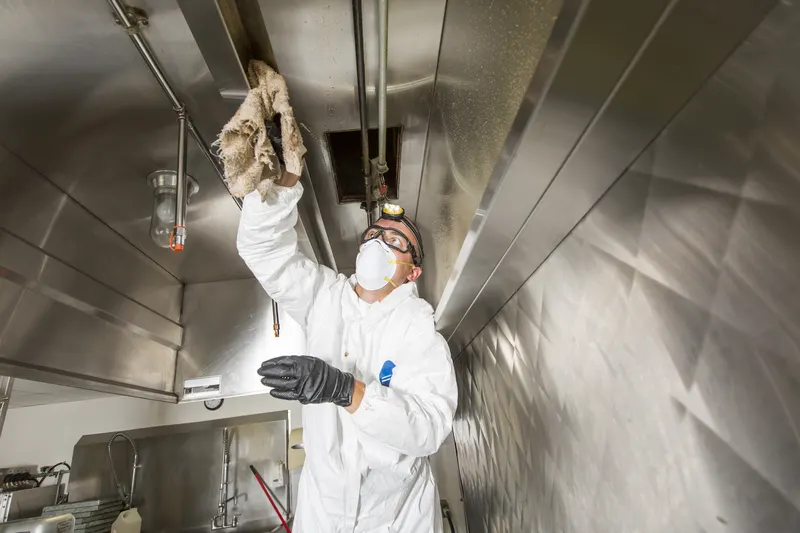
The Fire Code, made under the Fire Protection and Prevention Act, sets the obligations on a building owner and occupant, and for commercial cooking equipment it points to NFPA 96 for the technical content: what is inspected, how often, to what depth, and what is recorded. Toronto Fire Services carries the Fire Code into a Scarborough kitchen.
An operator who has never opened the standard is still bound by it: the Fire Code attaches to the building, and the published intervals are the minimum the law accepts.
What Toronto Fire Services looks for on a Scarborough inspection
Toronto Fire Services is the authority having jurisdiction for every kitchen in Scarborough. Scarborough has been part of the City of Toronto since 1998, and there is no separate Scarborough fire department.
An inspection tends to follow the paper first and the metal second. The inspector wants the latest cleaning record and reads it for the sections it actually names. A record listing the hood alone raises the question of whether the duct and fan were opened. The inspector then looks behind the filters at the plenum, at the duct access panels, at whether the rooftop fan can be opened, and at the date on the suppression tag.
Toronto Fire Services enforces. It does not issue cleaning certificates or endorse contractors. The certificate on file is the operator's evidence, and the inspector weighs it as evidence rather than proof. Toronto Public Health inspects food safety separately, and its inspection never goes up the duct.
Best NFPA 96 practice in Scarborough for charcoal and solid-fuel cooking
Solid-fuel cooking has its own chapter in NFPA 96, and Scarborough, with its charcoal grills, jerk drums and tandoor lines, has more of it than most places.
Charcoal and wood throw embers and particulate into the airstream along with grease, so the standard treats a solid-fuel line differently from a gas line. The inspection interval is monthly. The hood over the appliance carries a spark arrester so an ember cannot travel into a grease-lined duct, and where a solid-fuel appliance shares a kitchen with gas appliances the standard expects the solid-fuel exhaust to run on its own system.
Top-rated hood cleaning certificate in Scarborough: what it does and does not assert
A hood cleaning certificate records that particular sections of one exhaust system were cleaned on a given date by a named contractor, with reference to the published NFPA 96 standard. Nothing more.
What it asserts. The sections cleaned, by name: canopy, filters, plenum, horizontal duct, riser, fan. The date. The grease depth found where it was measured. A signature. That is the document Scarborough Hood Cleaning signs: a health and safety certificate backed by before-and-after photographs of every cleaned surface, which states that the work references the published NFPA 96 standard and that the business has no affiliation with NFPA.
What it does not assert. It is not a fire inspection and does not say the kitchen passed one. It does not cover a section it does not name. And no company can be NFPA 96 certified; that credential does not exist. NFPA publishes standards. It does not certify contractors.
How 0.078 inches is measured. 0.078 inches is 2 mm. The tool is a comb-style grease depth gauge pressed into the deposit where it collects: the plenum wall behind the filters, the inside of the duct at an access panel, the fan inlet. The tooth that touches metal gives the depth, and the reading goes on the certificate with its location.
The full-system scope is on the kitchen exhaust cleaning page, the canopy on the hood cleaning services page, the rooftop fan on the exhaust fan page, and every service on the services page.
How much does an NFPA 96 cleaning cost in Scarborough in 2026?
Scarborough Hood Cleaning prices a single-hood kitchen up to ten feet from $385 per visit and a multi-hood kitchen of two to four canopies from $725 per visit. Larger systems are quoted on site after a free walk-through, with the written quote back within 24 hours.
When the previous records are missing, the site visit report is the document to have, because it records the current state of the system against the standard in writing.
Next step: call 647-370-3454 or request a written quote. Have the last certificate at hand if one exists.
NFPA 96 in Scarborough: frequently asked questions
Does NFPA 96 apply to a church or community kitchen in Scarborough that cooks a few times a month?
NFPA 96 covers every commercial cooking operation that produces grease-laden vapour. Churches, day camps, seasonal businesses and senior centres appear in the published table with an annual interval.
Is a charcoal grill in a Scarborough restaurant inspected more often than a gas line?
Yes. Solid-fuel cooking carries a monthly inspection interval in NFPA 96, against quarterly for a high-volume gas line, because embers and particulate travel into a grease-lined duct.
Can a hood cleaning company be NFPA 96 certified?
No. NFPA publishes standards and does not certify companies, so the credential does not exist. A contractor claiming to be NFPA 96 certified is claiming something NFPA has never issued.
Is a hood cleaning certificate the same as passing a Toronto Fire Services inspection?
No. The certificate is the cleaner's own account of which sections were cleaned and on what date. The inspection belongs to Toronto Fire Services, covers the whole premises, and treats the certificate as one piece of evidence among several.
What does the Ontario Fire Code say about NFPA 96?
The Ontario Fire Code adopts NFPA 96 by reference for how commercial cooking exhaust systems are designed, installed, inspected and cleaned. NFPA 96 is the technical document it points to, and Toronto Fire Services enforces it in Scarborough.