Kitchen Exhaust Cleaning in Scarborough
Kitchen Exhaust Cleaning in Scarborough is the cleaning of the grease duct between the hood collar and the rooftop fan: the run that travels horizontally above the ceiling, the riser that climbs to the roof, and the access panels that let a crew reach each length. Scarborough Hood Cleaning opens every panel, degreases each section to bare metal, checks the NFPA 96 limit of 0.078 inches (2 mm) at each point along the path, and lists every section on a signed certificate. Plaza units on Kingston Road and stalls in the Golden Mile food halls share risers, and the certificate states where one tenant's duct ends and the building's begins.
Horizontal run, riser and access panels: the duct after the hood
The horizontal run leaves the duct collar on top of the hood and crosses above the kitchen ceiling toward the shaft. Every elbow and every change in duct size slows the air, and grease falls out of slow air. The outside wall of each turn carries the heaviest load in the run.
The riser climbs from the end of the horizontal run to the fan. Grease condensing on its walls drains downward, so the deepest pool in the whole system sits at the bottom of the riser where the duct turns up. Looking down from the roof shows the clean top and hides the loaded base.
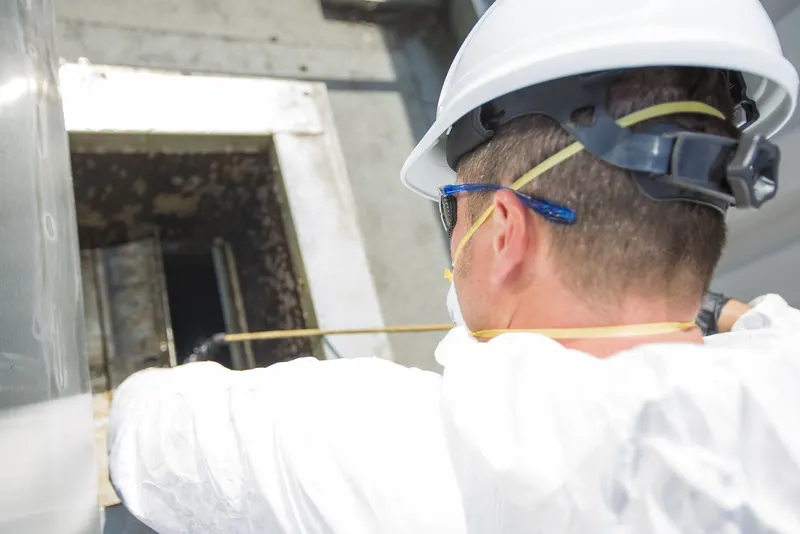
Access panels are gasketed doors cut into the duct wall so a crew can get inside. A run without them can be cleaned an arm's length past the collar and no further. Scarborough Hood Cleaning counts the panels on the walk-through and quotes any that are missing. The hood assembly has its own page under hood cleaning services, and the fan at the top of the riser is covered under exhaust fan repair.
Hood-only cleaning vs full-system cleaning in Scarborough
The two scopes leave the same clean canopy behind. Inside the duct, and on the certificate, they are not the same job.
| Section of the system | Hood-only vs full-system: hood-only | Full-system |
|---|---|---|
| Duct collar | Wiped from inside the plenum as far as an arm reaches. | Degreased through the first panel and measured for depth. |
| Horizontal run and elbows | Untouched. | Opened at each panel, the outside wall of every elbow scraped, photographed inside. |
| Riser base | Untouched. | The pooled deposit at the turn removed and photographed. |
| Fan inlet | Untouched. | Cleaned from the roof, the last surface before discharge. |
| Missing access panels | Not counted. | Counted on the walk-through, quoted and fitted before the clean. |
| What the certificate names | The hood. | Every section cleaned, plus every section not reached and why. |
NFPA 96 sets its cleaning frequency for the system as a whole, and the frequency table is on the NFPA 96 page.
Kitchen exhaust cleaning services for plazas and food halls with a shared riser
Scarborough Hood Cleaning records each tenant's branch duct as far as the junction and sends the riser quote to the party that owns the shaft.
Three or four food units feeding a single riser is the normal layout in the plazas along Kingston Road and Sheppard Avenue East, and a food hall at the Golden Mile plazas can put a dozen stalls on one shaft. Every tenant holds a certificate for its own hood. The shaft above them fills from every line at once and belongs to no tenant's certificate.
Scarborough Hood Cleaning writes the split down before anyone climbs a ladder. The tenant is responsible for canopy, plenum and branch duct as far as the junction; the building is responsible for the riser and the fan. The tenant's certificate names the point where the branch ends, the property manager receives the riser quote, and proof of WSIB coverage and liability insurance goes to both parties. A landlord who declines is noted on the tenant's record, which is the tenant's protection when Toronto Fire Services asks about the shaft.
Multi-storey risers in mixed-use buildings
A restaurant on the ground floor of a condominium or office tower sends its duct up through floors it does not own.
The newer mixed-use towers along Sheppard Avenue East, McCowan Road and near Scarborough Town Centre put a kitchen at street level and the fan on a roof ten or twenty storeys up. The riser passes through a fire-rated shaft on every floor between. Panels on that riser are reached from service corridors or mechanical rooms, each needing access arranged with building management.
A long riser drains a long way, so the pool at the base is deeper than in a one-storey plaza. The walk-through maps which floors carry a panel, which need one, and who holds the keys.
The 0.078 inch (2 mm) limit measured along the whole path
NFPA 96 sets the acceptable grease depth at 0.078 inches (2 mm), and the limit applies wherever cooking air passes, so the gauge goes to the places grease settles rather than the places a kitchen can see.
Every full-system record carries four readings. One at the collar, the first place the air slows after the plenum. One on the outside wall of each elbow, where the airstream throws its grease. One at the base of the riser, where everything above drains to. One at the fan inlet, the last surface before discharge.
No panel means no reading and no line on the certificate. The record marks that length as not accessible and prices the panel that would open it.
Where to find commercial kitchen exhaust cleaning near me in Scarborough
Commercial kitchen exhaust cleaning in Scarborough is worth judging on one thing: whether the contractor can show what the inside of the duct looked like before and after. A clean canopy proves nothing about the run.
Photographs through each panel. Dated, before and after, taken inside the run.
A panel count on the quote. A contractor who priced the job without tracing the run cannot say how many openings exist.
A certificate with one line per section. Collar, run, each elbow, riser, fan inlet, and a separate list of anything not reached.
A named party for the shared riser. The quote should say who is paying for the shaft.
Scarborough Hood Cleaning holds to that standard from Milliken to Port Union, and the neighbourhood list is on the areas served page.
How much does kitchen exhaust cleaning cost in Scarborough in 2026?
Scarborough Hood Cleaning charges from $385 per visit for a single-hood kitchen up to ten feet and from $725 per visit for a multi-hood kitchen of two to four canopies. Shared-riser and larger systems are quoted on site after a free walk-through, with the written quote back within 24 hours.
The duct sets the hours: how long the run is, how many elbows it has, how tall the riser is and how many panels already open. Missing panels get their own line, and a shared riser gets a second quote made out to the building.
Next step: call 647-370-3454 or use the contact page. Worth mentioning: whether the unit shares a shaft with a neighbour, how many floors separate the hood from the roof, and whether any duct panel has been opened before. The rest of the services are on the services page.
Kitchen exhaust cleaning in Scarborough: frequently asked questions
Who pays for the shared riser in a Scarborough plaza?
Usually the landlord. Most commercial leases treat the riser and the fan as common elements, with each tenant responsible for its own hood and branch duct. Scarborough Hood Cleaning issues two quotes and marks on the tenant's certificate exactly where the tenant's duct ends.
How many access panels should a duct run have?
One for every section that needs cleaning. NFPA 96 expects the whole duct to be reachable, which in practice means a panel close to the collar, another at every change of direction, and another at the foot of the riser.
Does cutting a new access panel weaken the duct?
No. A compliant panel is a framed opening with a gasket that seals tight under fan suction and opens again at every future visit. The weak point is the length of duct nobody can reach, not the door that reaches it.
Can the duct be cleaned without opening the dining room ceiling?
In most kitchens, yes. The run sits over the kitchen ceiling and the panels open from the kitchen side or a rear corridor. When a run passes over the dining room, the tiles come down and go back up inside the same overnight window.
Is the 2 mm limit the same inside the duct as on the hood?
Yes. NFPA 96 does not relax the figure for surfaces that are hard to reach. A depth that fails the plenum fails an elbow or a riser base too, and those are the surfaces carrying the most grease. The standard itself is on the NFPA 96 page.