Terms and Conditions
The Terms and Conditions of Scarborough Hood Cleaning are the rules under which a hood, duct, rooftop fan or deep-cleaning visit is quoted, booked, carried out, documented and paid for. The website itself is not a contract. The written quote issued after the free site visit is the contract for that job; if anything on this page conflicts with a line on the quote, the quote governs. These terms cover work in Scarborough and are governed by the laws of Ontario. Effective date: September 2026.
The written quote
What a quote covers. The quote describes the system by its parts: each canopy, the filters, the plenum, every section of duct that will be reached, and the rooftop fan. It gives a price for that scope and lists separately any item that needs its own approval, such as cutting an access panel, replacing a damaged filter or fitting a hinge kit to a bolted fan. An item that is not on the quote is not on the invoice.
How long a quote stands. A quote holds its price until the date printed on it. After that date, or if the menu, the hours or the equipment have changed since the walk-through, confirm the quote by phone before booking. Each of those changes alters how much grease the system carries.
The prices on this website. From $385 per visit for a single-hood kitchen up to ten feet, and from $725 per visit for a multi-hood kitchen of two to four canopies, are entry prices for straightforward systems. They tell a kitchen the order of magnitude. They are not an offer for any particular system. Larger and shared systems are quoted on site after a free walk-through, and fan repair and deep cleaning are quoted per job after inspection.
Conditions found once the system is open. If a section proves corroded, blocked, inaccessible or unsafe to work on, work on that section stops and you are contacted before anything else happens. No item is added to the invoice on the assumption that you would have approved it.
The certificate: what it records and what it does not claim
What it records. Every visit closes with a signed health and safety certificate referencing the published NFPA 96 standard. It states which sections were cleaned, the grease depth found, and the date. Before-and-after photographs of every cleaned surface go with it. Any section that could not be reached is named on the certificate with the reason, so the record is accurate.
What it does not claim. The certificate is not a fire inspection. It is not a pass, an approval or a sign-off from Toronto Fire Services, the authority having jurisdiction in Scarborough. It is not an engineering report on the ductwork, and it is not a credential of any kind. Scarborough Hood Cleaning references the published NFPA 96 standard and is not affiliated with NFPA. NFPA does not certify cleaning companies, so no company can hold a credential from NFPA and this one claims none.
Staying compliant between visits. Keeping to an interval that suits the cooking load is one element of compliance with the Ontario Fire Code, which adopts NFPA 96. Keeping the certificates on file, maintaining the suppression system and operating the line safely between visits remain the responsibility of the kitchen. The NFPA 96 guide sets out what the standard asks for and what an inspector looks at.
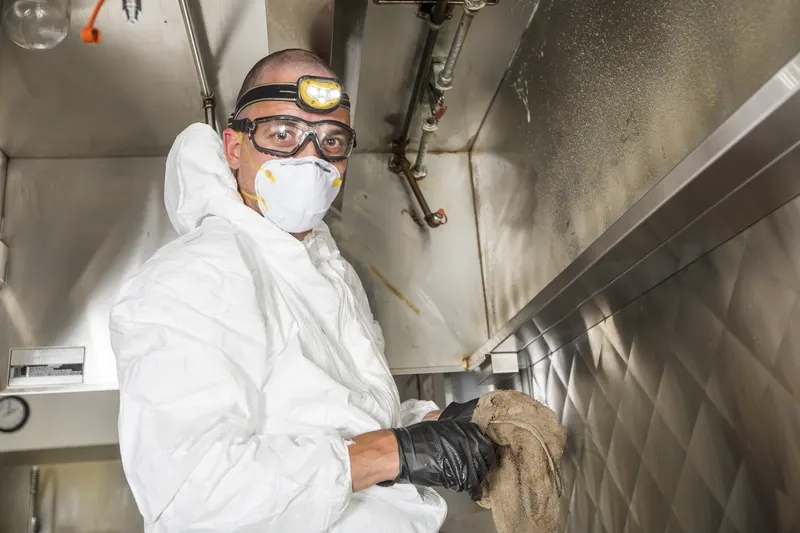
Site access, safety, scheduling and cancellation
Getting in. You arrange entry to the premises at the agreed time and permission to go on the roof. A tenant in a plaza or a mixed-use building rarely controls the roof, so the landlord or property manager usually has to agree and a key holder has to be reachable on the night. Start that conversation as soon as the quote arrives.
Power to the fan. Nobody works on the rooftop fan until it can be isolated at its disconnect. Where no disconnect exists, the walk-through records that fact and the fan may sit outside scope until an electrician installs one.
The line ready. Cooking equipment cooled, food covered or removed, and kitchen staff off the line for the duration of the visit. A charbroiler still throwing heat is unsafe to work above, and every minute the crew waits for it to cool comes out of the overnight window you booked.
Scheduling. Visits run overnight or between services so the kitchen is not closed during trade. An institutional kitchen with a fixed shutdown should book far enough ahead that the visit lands inside it.
Cancellation and rescheduling. Reasonable notice is expected in both directions. An overnight window cancelled at the door cannot be filled by another kitchen that night. If a cancellation charge exists for a job, it is the one written on that quote and nothing else. A visit that this business cannot honour is moved to the earliest workable date at no charge to you.
Scope, payment, insurance and governing law
In scope. Exhaust hood cleaning, exhaust duct cleaning, rooftop fan cleaning, exhaust fan repair and installation, and commercial kitchen deep cleaning. Each is described on its own page, reached from the services hub.
Out of scope. Residential range hoods (NFPA 96 governs commercial cooking, and domestic kitchens are not served), HVAC and air duct cleaning, coil cleaning, dryer vents, janitorial and nightly cleaning contracts, grease interceptor pumping, roofing, gas fitting, electrical work and fire suppression servicing. Where one of those turns out to be the real fix, it is reported and referred to the right trade rather than attempted.
Payment. The invoice matches the quote plus any item you approved in writing after it was issued. Payment terms are stated on the quote and repeated on the invoice. The certificate and the photographs are released when the visit is complete.
Insurance and liability. Proof of WSIB coverage and liability insurance is supplied before work starts. Existing damage, whether corroded duct, a split roof curb or a torn membrane, is photographed before the first spray so any later question already has its answer. No responsibility is accepted for the result of a third-party inspection, for conditions that were not disclosed at the walk-through, or for equipment that was not within the quoted scope.
Governing law. Ontario law, together with the federal laws of Canada in force in Ontario, governs these terms and every job carried out under them.
Questions. Anything on this page can be checked by calling 647-370-3454 or writing through the contact page. What happens to the details you send is covered by the privacy policy.
Terms and conditions: frequently asked questions
What happens if the crew finds duct the quote did not include?
The extra section is reported and photographed where it can be seen, then quoted as its own item. It is not cleaned and billed without your approval. The certificate for that visit lists the sections that were in scope and records the extra one as not reached, with the reason, so the paperwork stays honest.
Does the certificate mean the kitchen passes a fire inspection?
A cleaning certificate and a fire inspection are two different documents. When Toronto Fire Services inspects, it looks at the entire premises that day: suppression system, extinguishers, exits, storage, none of which a cleaning crew handles. What the certificate attests is that the exhaust system was cleaned against the referenced standard on a stated date, and that is the only claim a cleaning company is in a position to make.
Who approves and pays for a hinge kit or an access panel?
The party that owns that part of the system. In a plaza the rooftop fan and the building duct usually belong to the landlord, while the canopy and its branch usually belong to the tenant. Each such item is quoted on its own line so the right party can say yes to it, and it is never folded into the cleaning price.
What if nobody can open the roof on the night?
Everything reachable from inside the kitchen is cleaned, and the fan is recorded as not reached. The invoice reflects the work actually done, and the fan is rebooked for a night when a key holder is available. Settling roof access before the first visit is the way to avoid paying for two.
Can a recurring interval be changed once it is set?
An interval can be changed by either side with reasonable notice. Any change to the menu, the hours or the equipment is a reason to revisit it: a charcoal grill added to the line, or a second daily service, will load the system faster than the interval was set for. Price and scope for a recurring visit stay as written until both sides agree a change.